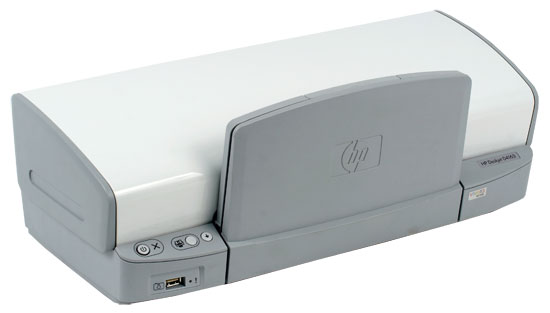
amazon

Showing posts with label office copy machine reviews. Show all posts

2011/01/20

Copy machine reviews Xerox Phaser 3140

Copy machine reviews Xerox Phaser 3140


In late 2009, Xerox has launched its new brainchild - monochrome laser printer is an entry-level Xerox Phaser 3140. This printer replaces the most popular to date models in the line of personal printers - Xerox Phaser 3117.
If you read the specifications above mentioned models, we can see that Phaser 3140 outperforms its predecessor in almost all respects. In addition, it has an attractive design and is offered on the market at affordable retail prices.

Design and constructive.

The printer is a really lightweight and compact: its size in breadth, depth and height are 360 x 389 x 230 mm and weighs just under 7.5 kg. Creating a printer, the designers have invested considerable effort in the liberation of the working space on the desk, where it will be located, but more on that below.
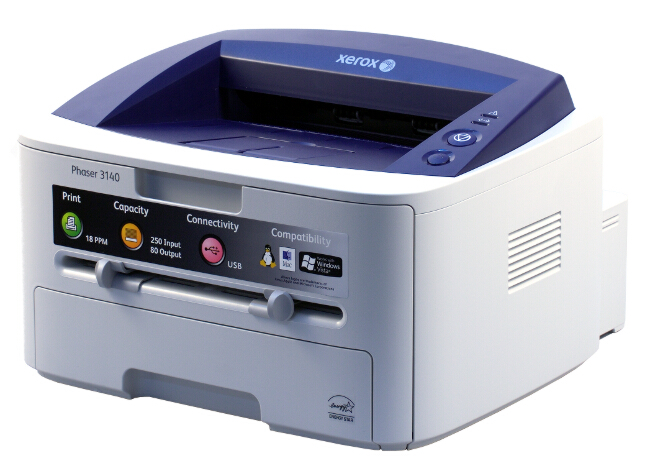


Paper tray at the Phaser 3140 is rated at 250-sheet (half of a standard pack), that the device of this class, perhaps, is optimal and sufficient. Interestingly tray location: it "pushed" inside the printer, but the protruding rear part of the carefully covered the square cover is very reminiscent of auto-duplex externally.
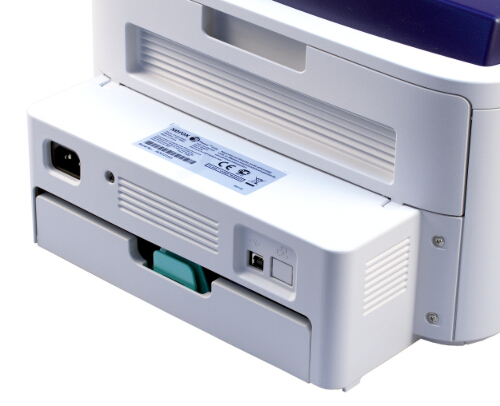

On the rear panel have connectors for power cable and USB-connector.
Actually duplex in the printer is there, but sheet feeding is done manually through a special "slot". Output tray in the printer serves as the upper lid, which fits 80 ready prints.

No display, nor any additional funds to be segregated operation of the device in the Phaser 3140 is not provided. On the top cover are the power button and the delete / continuation tasks, as well as a pair of colored indicators.

Cartridge standard volume in 1500 with the number of prints 108R00908 will cost the user about 2000 rubles. But the cartridge with extended Toner us in the sale could not be found.


As a result,
Perhaps, any thing, sooner or later there is a buyer. But not all things can easily imagine a typical customer. In the case of Xerox Phaser 3140, this problem is very simple. The device is designed for the budget sector of the market for users who are as important as saving the time of purchase and get a Mighty apparatus which will quickly and correctly to print, publish and print ....

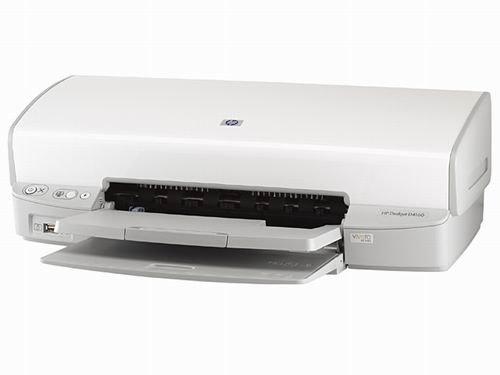
Copy machine review HP Deskjet 4163


Copy machine review HP Deskjet 4163


This is a nice little printer is surprisingly fast and functional. Speed is 30 ppm for monochrome printing and 23 ppm in color, with printing photos printer also works fine. Resolution in black and white printing is 1200x1200 dpi, and four nozzle per pixel (cyan, magenta and yellow plus black) allow you to print color images with resolution up to 4800x1200 dpi. HP Deskjet 4163 can print borderless photos width of 21.59 cm and length 60.96 cm Low price printer, which is about $ 89, explains why HP Deskjet 4163 does not support direct printing of photos from other devices and has no card slot memory.


Built-in photo processing in the printer HP Deskjet 4163 includes support for adaptive lighting technology (HP Adaptive Lighting) to improve the brightness and contrast of images, as well as the ability to automatically remove red-eye reduction "(HP Auto Red-eye Removal). The printer supports paper sizes are "letter", "standard" format and cards, as well as "postcards" and "number 10 envelopes. HP Deskjet 4163 can print borderless photos size 10x15, 13x18 and 20x25 cm and panoramic images of size 10x25, 10x28 and 10x30 cm


HP Deskjet 4163 is quite compact (45,90 x 22,10 x 17,02 cm) in comparison with other printers in this review. The weight of its too small - 3.48 kg. The printer works with all modern versions of Windows from 98SE to Vista, as well as Mac OS X 10.3.x and 10.4.x.


Consumables include toner black ink cartridge and three color ink. Both cartridges cost about $ 20, while buying two at once granted a small discount and get $ 36. Special photo cartridge costs about $ 25. HP also offers a variety of photo paper at prices as for the HP Business Inkjet 1200d, discussed above.


More information about the HP Deskjet 4163 can be found at HP.

Copy machine reviews Canon PIXMA MP250


Copy machine reviews Canon PIXMA MP250


Copy machine reviews

I do not advise

Bought this unit a year ago. In principle, the prints, but it creates a lot of noise for a long time thinking before napechat page. Cartridge quickly ends.
Too bulky. In general, it is worth collecting dust.

Pros: Not found
.
Cons: Slow, bulky, print cartridge ends too soon, too much noise.

Excellent printer for the money.

I bought a couple of months ago. Problems were found.
Prints clearly and quickly ... However, I do not compare with anything: before the printer was not. Scans are not bad too. Even from the book (rather thick), fine scans the pages. Unique, something suspiciously quickly ran out the black ink, although a little typing, and mostly in the "quick print".

Pros: Fast, clear, inexpensive)).
Cons: Quickly run out of ink.

Excellent model!
I use MP-250 a year ... Thank God, but no incidents were not. Satisfied with everything.
The quality of printing and scanning is very, very good! About the ink: printed about half a year, alternating between color and black cartridges at standard conditions. 

Pros: Very, very worthy model!
Cons: There is little, because in any struynike anyway ink much faster than a laser.

Office copy machine reviews Canon i-SENSYS MF4018.

Canon i-SENSYS MF4018

Canon i-SENSYS MF4018

Canon i-SENSYS MF4018


Canon i-SENSYS MF4018

Office copy machine reviews Canon i-SENSYS MF4018.


Excellent.

Really decent machine, High speed scanning and printing. For infrequent use of very good option, I had the cartridge for more than a year. Refilling cost cheap. Installing the driver settings without any problems.

Pros: High speed scanning.
Cons: No problems found. The only driver on Linux can not deliver.

Best printer for its price.

An excellent device. The quality is much better cost-type HP 1006. Refueling without a problem, the toner from HP. Copy Cartridge HP does not kill the drum, too, a large amount of toner.
There were problems with printing on letterhead, because they are already the norm.

Pros: clear printing, cheap toner, beautiful appearance.
Cons: problems with printing on paper and sometimes on the network.

Super!!!!

Bought 2 months ago. typing a lot and often, has never let even the paper has never jammed. very high print quality, the scanner is excellent, even recognize colors. Hi weaker than a little bit, but I do not and need. I'm just ecstatic.

Pros: very reliable.
Cons
: not found
.

Copy machine reviews Samsung ML-1665


In the end ... you buying doskanalno know how and where to run by! To work no complaints!


Bought in October. Opted for money, brought home, software was no problem, (W / 7). Exterior view of 9 looks great! Well, I thought that last page 700. In the end, enough for 100-130 pages. Print speed is excellent, and the quality of ... 4 font of the text read (have not tried lower).
Pluses: Fast print speed, print quality, ease of use.
Cons: A little cartridge.

How to choose a copying machine.

Nitially, we recommend to answer questions and perform some action on the proposed scheme:

1. Defining the purpose.

Documents of any format, you will copy (A4, A3).
Will you copy double-sided documents.
Calculate the approximate volume of up to a month.
How many people will have access to a machine and needs to be consideration of their work.
2.Choice of brand copier.

Make sure that the name of the copier - it's not just a brand name and the name of the company - the manufacturer.
Please note that the firm has specialized manufacturer, the more you can count on quality and reliability engineering.

3. Selection and comparison of specific models.

A comparison of selected models for your option SALT (TCO). That is, any amount you spend on the acquisition and maintenance of the device for a certain period of time with a certain amount of copying. The fact is that when making copies of spent several kinds of materials. Usually, this toner (powder forming the image), the developer (powder involved in the process of image transfer), drum (with its toner is transferred to the sheet) and the drum cleaning blade.
A comparison of functional capabilities.

4.The choice of the seller.

Specify - whether is the firm-seller the official representative of the manufacturer of the device. If isn't - badly (problems with spare parts and expendable materials are possible). If is the dealer - well. If the distributor - the best variant (direct deliveries, the warehouse, reliability). Ask to show documents.

Find out - what level of service warranty service and послегарантийного service offers you firm-seller. The engineers working in firm should have certificates.


copy machine reviews (Kyocera)


Among the products the corporation Kyocera Mita, the world's leading copier, printer and multifunction office equipment, are monochrome copiers Kyocera Mita KM Series. Cheap, compact and highly efficient, laser copiers Kyocera KM - the best solution for the modern office. The most popular and widespread among copiers Kyocera is a model Kyocera KM-1500. This model weighs only 14 kg and dimensions 38h38 cm does not require a lot of space to house and provides high-quality copying A4 sheets at a speed of 15 copies per minute.
Model Kyocera KM-1500 allows print without refueling Toner 6.000 copies (A4 standard pages 6%). 600 dpi resolution and 256 shades of gray is a guarantee of high quality copies. RAM 16 MB, which is equipped with a model Kyocera KM-1500 significantly extends the capabilities of the copier. If necessary, the model can be optionally equipped with RAM in 16, 32, 64 or 128 MB. Model Kyocera KM-1635 and KM-2035 - a more powerful copier Kyocera, designed for workgroups and large offices. In contrast to the model KM-1500, these copiers Kyocera designed not only for A4, but also on A3 sheets. If necessary, these models can be supplemented printer system. Both models provide print 15.000 copies of the A4 with the filling of 6% to replace the toner. Copiers Kyocera KM-1635 and KM-2035 are equipped with a device memory of 32 MB.
Model KM-1635 offers printing at 16 pages per minute in A4 format and 8 pages per minute in A3, as well as the possibility of an autonomous two-sided copying. The paper tray holds 300 sheets, and its capacity can be increased up to 1250 sheets.
Model KM-2035 is fast printing (20 or 10 pages per minute, depending on size).
In addition to the basic models KM-1500 KM-1635 and KM-2035, Kyocera copiers are also monochrome laser models KM-6030 KM-8030, which can be further staffed with scanner and printer. Both models are designed for use with A4 and A3. Model KM-6030 provides the ability to copy at 60 pages per minute for A4 and 31 pages per minute for A3. Automatic feed system, designed for 200 sheets, can greatly expedite the work.
The main difference between models Kyocera KM-8030 - it's speed, which is 80 liters per minute for A4 and 41 l / min for the A3. Kyocera color copiers are traditionally represented in the form of constituents of multifunctional devices Kyocera.

History copy machine parts 2


In 1944, the Battelle Souvenir Institute, a non-profit design in Columbus, Ohio, contracted with Carlson to hone his new process. Over the next five years, the guild conducted experiments to develop the process of electrophotography. In 1947, Haloid Corporation (a insignificant New York-based producer and seller of photographic scrap) approached Battelle to gain a license to develop and peddle a copying machine based on this technology.

Haloid felt that the parley \"electrophotography\" was too complicated and did not be undergoing good recall value. After consulting a professor of weighty language at Ohio State of affairs University, Haloid and Carlson changed the christen of the process to \"xerography,\" which was derived from Greek words that meant \"dry penmanship.\" Haloid called the new copier machines \"Xerox Machines\" and, in 1948, the term \"Xerox\" was trademarked. Haloid ultimately changed its name to Xerox Corporation.

In 1949, Xerox Corporation introduced the gold medal xerographic copier called the Likeness A.[1] Xerox became so well-known that, in North America, photocopying came to be widely known as \"xeroxing.\" Xerox has actively fought to hamper \"Xerox\" from suitable a genericized trademark. While the tete--tete \"Xerox\" has appeared in some dictionaries as a synonym for photocopying, Xerox Corporation typically requests that such entries be modified, and that people not use the phrase \"Xerox\" in this way. Some languages list hybrid terms, such as the very much used Polish interval kserokopia (\"xerocopy\"), equable though relatively few photocopiers are of the Xerox marque.

In the near the start 1950s, Radio Corporation of America (RCA) introduced a altering on the process called Electrofax, whereby images are formed straight away on specially coated report and rendered with a toner dispersed in a shining.

During the 1960s and from one end to the other the 1980s, Savin Corporation developed and sold a word of liquid-toner copiers that implemented a technology based on patents held by the retinue.

Previously to to the widespread adoption of xerographic copiers, photo-unswerving copies produced by machines such as Kodak\'s Verifax were against. A primary obstacle associated with the pre-xerographic copying technologies was the lofty cost of supplies: a Verifax stamp required supplies costing USD $0.15 in 1969, while a Xerox stamp could be made for USD $0.03 including journal and labor. At that in good time, Thermofax photocopying machines in libraries could publish letter-sized copies for USD $0.25 or more (at a then when the minimum wage for a US tradesman was USD $1.65).

Xerographic copier manufacturers took sway of a high perceived-value of the 1960s and premature 1970s, and marketed speech that was \"specially designed\" for xerographic crop. By the end of the 1970s, paper producers made xerographic \"runability\" one of the requirements for most of their role paper brands. Some devices sold as photocopiers bear replaced the drum-based technique with inkjet or transmission film technology. 

History copy machine parts 1


The commencement widely used twin machine for offices was invented by James Watt in 1779. It relied on physically transferring some of the (especially formulated) ink from an primary letter or drawing to a moistened narrow unsized sheet of identification b docket by means of a press. The twin could then be interpret from the obverse side. The practice was a commercial success and was in use in for past a century. In 1937, Bulgarian physicist Georgi Nadjakov set up that, when placed into an stimulating field and exposed to lantern, some dielectrics secure permanent electric polarization in the exposed areas. That polarization persists in the overcast and is destroyed in light.

Chester Carlson, the inventor of photocopying, was at a patent attorney, as amply as a part-time researcher and inventor. His job at the apparent office in New York required him to skedaddle a large number of copies of formidable papers. Carlson, who was arthritic, establish this to be a painful and automatic process. This motivated him to carry experiments with photoconductivity. Carlson occupied his kitchen for his \"electrophotography\" experiments, and, in 1938, he applied for a grant for the process. He made the basic photocopy using a zinc lamination covered with sulfur. The words \"10-22-38 Astoria\" were written on a microscope skim, which was placed on top of more sulfur and under a bright light. After the move was removed, a mirror icon of the words remained. Carlson tried to tattle on his invention to some companies, but failed because the course of action was still underdeveloped. At the lifetime, multiple copies were most commonly made at the implication of document origination, using carbon dossier or manua


I